
Have you ever stood beneath a massive dome and felt incredibly small, yet strangely inspired at the same time? That feeling is universal whether you’re in Washington D.C. staring up at the Rotunda of the United States Capitol, or in Rome watching sunlight pour through the oculus of the Pantheon.
Both structures were built in completely different eras, yet share one powerful quality, they were designed to impress. Not just with size or decoration, but with symbolism. One represents a modern republic built on democracy. The other represents an ancient empire that believed in eternity.
In this guide, we’re going to explore the features of the U.S. Capitol and Rome’s Pantheon, breaking down their architecture, history, and visitor experience. Whether you’re comparing them for education, planning a trip, or simply curious about what makes these domed wonders so famous, this side-by-side journey will give you a deeper appreciation of both.
And if you ever find yourself in Rome, trust me, walking past the Pantheon without stepping inside is a mistake you don’t want to make.
Quick Comparison of the Most Striking Features
Before we dive deeper, here’s a simple comparison to get a clear view of how both buildings line up:
| Feature | U.S. Capitol | Pantheon, Rome |
|---|---|---|
| Location | Washington, D.C., United States | Piazza della Rotonda, Rome, Italy |
| Year Completed | 1800 (with later expansions) | 126 AD |
| Original Purpose | Seat of U.S. Congress | Temple to Roman Gods |
| Current Use | Government and ceremonial space | Basilica and national monument |
| Architectural Style | Neoclassical with American symbolism | Roman temple with Greek-inspired portico |
| Dome Design | Cast-iron dome with frescoes inside | Massive concrete dome with open oculus |
| Visitor Access | Free guided tours | Free entry or paid guided tours / audio guides |
Both buildings look very different at first glance, but their purpose was surprisingly similar: to make people look up, reflect, and feel part of something much bigger than themselves.
Historical Origins of Each Monument
How the Rome Pantheon Came to Be
The Pantheon is one of those buildings that makes you wonder how ancient engineers pulled it off without cranes, steel, or modern machinery. The structure we see today was completed around 126 AD during the reign of Emperor Hadrian, though it replaced two earlier temples destroyed by fire.
Its name comes from the Greek words pan (all) and theos (gods), meaning Temple of All Gods. But here’s what’s fascinating, historians still aren’t completely sure how it was used. Some believe it served as a temple, others think it was more of a ceremonial gathering space.
Eventually, in the 7th century, it was converted into a Christian church. That decision is likely what saved it from destruction during the Middle Ages when many ancient Roman buildings were stripped or taken apart. Because it became a church, it stayed intact. Today, it is one of the most well-preserved buildings from all of antiquity.
Standing inside, you can feel that it was always meant to last.
The Birth of the United States Capitol
Now jump forward almost two thousand years to a much younger country. The founders of the United States needed a building that would represent unity, power, and stability. Something that could match or even rival the great structures of Europe.
Construction of the U.S. Capitol began in 1793, and like many great buildings, it wasn’t completed overnight. It grew and evolved with the nation itself. Fires destroyed parts of it. Wars delayed it. Yet it stood strong and was rebuilt every time.
The dome we see today wasn’t the original one. That came later in the mid-1800s when a larger and grander version was created from cast iron. It was intentionally designed to be taller than any building in the capital, a signal to all that law and representation stand above everything else.
Unlike the Pantheon, which carries spiritual symbolism, the Capitol was built to embody democracy. One is a temple for gods. The other is a house for the people.
Key Architectural Features of the U.S. Capitol
The U.S. Capitol is more than just a government building. Every inch of it was designed to send a message. When you walk toward it, you’re met with a grand staircase, tall Corinthian columns, and a massive dome that dominates the skyline of Washington D.C. It is meant to look important, and it does.
The Dome That Defines a Nation
The dome is the most recognizable feature of the Capitol. Made of cast iron and painted to resemble stone, it’s far larger than most people expect when they see it in person. Standing beneath it in the Rotunda is an experience in itself. The ceiling rises 180 feet above your head, with a huge fresco called The Apotheosis of Washington painted inside. George Washington is shown ascending to the heavens, another reminder that this dome is meant to inspire.
The Rotunda – A Room Built for History
The Rotunda is a circular hall used for ceremonies of great honor, such as lying-in-state services for presidents. Massive paintings and sculptures line the walls, telling stories of the nation’s founding. It feels like walking into a history book, only much grander.
Statuary Hall and the People Represented Within
Every U.S. state is allowed to send two statues to be displayed inside the Capitol, honoring important figures from their history. This creates a sense of shared ownership, the building isn’t only for politicians. It represents every citizen.
Underground Visitor Center
Unlike centuries-old monuments like the Pantheon, the Capitol has modern conveniences. Beneath the main building, there’s a large visitor center filled with exhibits, theaters, and organized tours. You don’t simply walk in on your own, you are shown around with purpose, ensuring everything is understood and respected.
The structure may be old, but its message remains fresh: this is a place where the voice of the people lives.
Key Architectural Features of Rome’s Pantheon
If the Capitol is about order and symbolism, the Pantheon is about mystery and perfection. Its proportions are so precise that even modern architects still study it.
The Portico — A Temple Entrance Frozen in Time
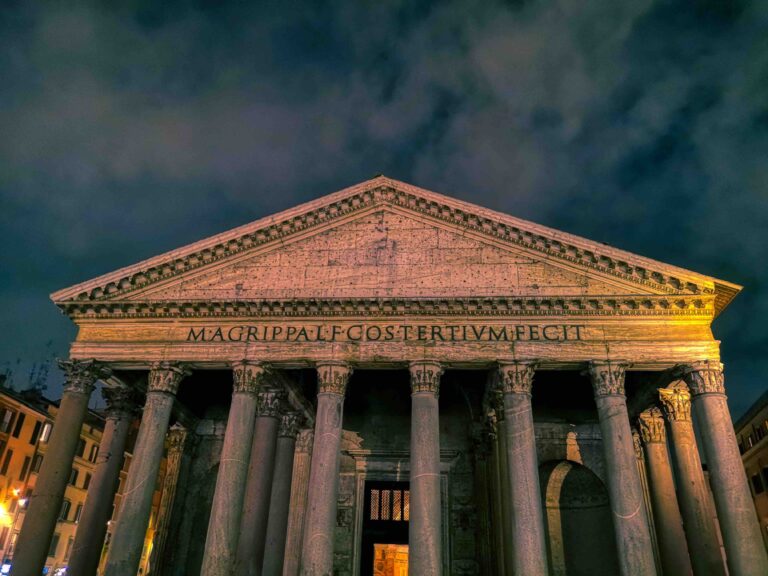
Before you even enter, you’re greeted by 16 massive granite columns taken from Egypt. They’re not replicas. They were carved thousands of years ago and transported across the Mediterranean. Each one weighs about 60 tons. No one truly knows how they were lifted into place, which adds a sense of wonder even before stepping inside.
The Dome That Defies Logic
The Pantheon’s dome is still the largest unreinforced concrete dome in the world. Almost 2,000 years later, nobody has surpassed it using the same ancient method. From the outside, it looks heavy and solid, but step inside and everything changes. The dome appears to float. It’s perfectly round, representing the heavens.
The Oculus — A Hole in the Sky
At the very top, there’s a circular opening called the oculus. It’s 27 feet wide and open to the sky, no glass, no covering. Rain falls directly inside. Light moves across the walls like a slow, silent spotlight. Many visitors say this single feature is what makes the Pantheon feel alive.
Marble, Tombs, and Acoustics
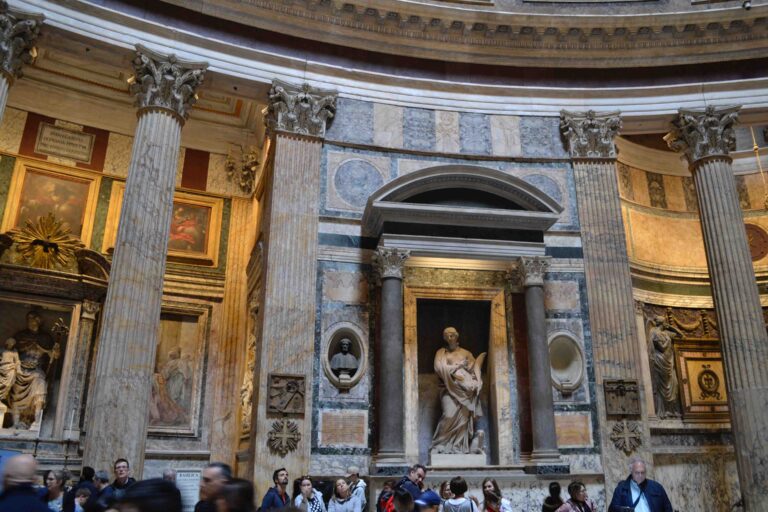
The floor is made of colorful marble arranged in geometric patterns. Inside, you’ll find the tombs of Italian kings and the famous artist Raphael. If you stand at the center and speak softly, your voice echoes back like a whisper from the past.
Compared to the U.S. Capitol, the Pantheon is far simpler. But simplicity can be powerful. It’s not covered in decoration because it doesn’t need to be. The structure itself is the decoration.
Symbolism and Cultural Significance
Though these two landmarks were built in different eras and for different purposes, they share one core mission, to represent ideals larger than any single person.
The Capitol – A Temple of Democracy
Everything about the Capitol reflects unity and representation. The dome, rising above all other structures in Washington, signals that law stands above wealth and power. The Rotunda serves as a national memory hall. Every statue, mural, and inscription tells a story meant to remind visitors of shared values.
The Pantheon – A Temple of Eternity
The Pantheon doesn’t speak in words or symbols. It speaks with silence. The open oculus connects earth and sky. The dome’s circular shape suggests eternity. It invites reflection without forcing meaning.
Where the Capitol says, “We are one nation,” the Pantheon whispers, “You are part of something eternal.”
Visitor Experience – What It’s Like to Tour Each One
Touring the U.S. Capitol
A visit to the U.S. Capitol feels structured and official, but in a good way. You don’t just wander in, you enter through the modern visitor center, check in for a scheduled tour, and follow a guide who walks you through the building’s most important rooms.
As you move through the halls, you notice how everything is designed to reflect national pride. The air feels serious, yet awe-inspiring. When you step into the Rotunda and look up at the dome, there’s always a pause. Even school groups go silent for a moment.
You’re not just visiting a historic site, you’re standing where laws are debated, where presidents have walked, and where history is still being written.
Best tip: book tours ahead of time online through your representative or the official visitor website. Early morning entries are quieter and easier to enjoy.
Touring the Pantheon in Rome
The Pantheon, unlike the Capitol, is open to anyone. You walk across a cobblestone square, pass by street musicians and cafés, and suddenly, there it is, standing quietly and confidently as it has for nearly two thousand years.
You step through heavy bronze doors, and the sound outside fades instantly. It’s like entering a different world.
Light pours through the oculus and slowly drifts across the curved walls. No ceiling lights. No loud speakers. Just natural light and silence.
Some people stay for five minutes. Others stay for an hour. You can explore freely or take a guided audio tour that explains the hidden meaning behind its design. And if you’re lucky enough to visit when it rains, you’ll see drops falling through the oculus like a gentle indoor storm.
Best tip: visit early in the morning or late afternoon for softer lighting and fewer crowds. For a deeper understanding, take a guided Pantheon tour, you’ll never look at the building the same way again.
Which One Should You Visit First?
It depends on what you want to feel.
- If you love history and ceremony, start with the U.S. Capitol. It’s a place where ideals are presented through structure and order. Every hallway tells a story, and every corner reflects national pride.
- If you love silence, mystery, and ancient engineering, start with the Pantheon. It doesn’t try to persuade you, it simply exists, waiting to be understood.
- For architecture fans, both are essential. One shows how ancient design influenced modern democracy. The other proves that some engineering simply never goes out of style.
But if you’re lucky enough to visit Rome, don’t just walk past the Pantheon like a regular building. Go inside. Stand at the center. Let the light touch you. That moment stays with you.
Frequently Asked Questions
Is the U.S. Capitol inspired by the Pantheon in Rome?
Not directly, but both buildings share classical influences. The Capitol borrows elements from Roman and Greek temples, and the Pantheon is one of the finest examples of those designs. So, while not identical, they are connected through architectural lineage.
Can you go inside the U.S. Capitol dome?
General visitors can’t climb all the way up, but they can view the dome from below in the Rotunda. Special tours sometimes allow access to the upper galleries.
Do you need tickets for the Pantheon in Rome?
Entry is free for basic visits, but guided audio tours or hosted experiences offer much more insight and context. They’re worth considering if you want the full experience.
Why does the Pantheon have a hole in the ceiling?
The oculus is there to symbolize the connection between earth and heaven. It also serves as the only source of light inside.
Which dome is bigger, the Capitol or the Pantheon?
The Pantheon dome is wider, while the Capitol dome is taller. Each is impressive in its own way.
Final Thought – Two Domes, Two Messages
When you stand beneath the dome of the U.S. Capitol, you feel the weight of responsibility, the energy of a nation constantly evolving. It’s a reminder that freedom is something living, active, and shared.
When you stand beneath the dome of the Pantheon, you don’t feel urgency. You feel peace. Time slows. Light drifts above you like a silent blessing.
Both buildings lift your eyes upward, not just to admire architecture, but to think beyond yourself.
So whether your journey is through history books or airplane tickets, I hope you carry this with you: great architecture isn’t built just to be seen. It’s built to be felt.
And if you ever find yourself in Rome, step inside the Pantheon. Don’t rush it. Let it speak to you.