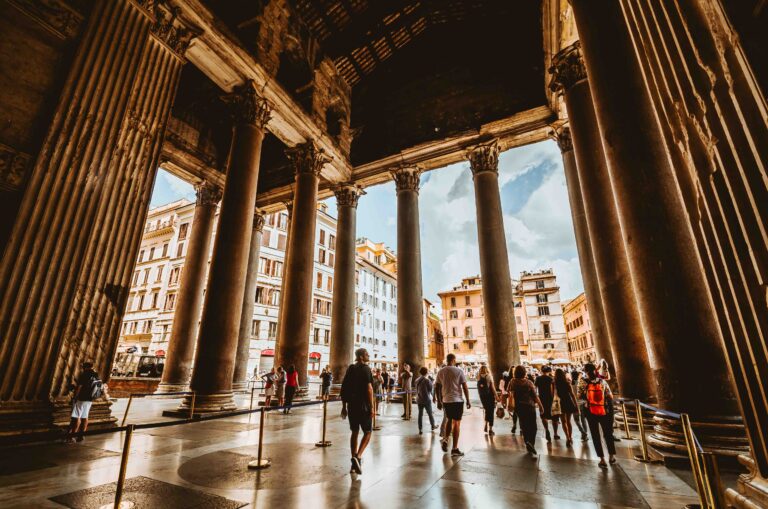
Most people walk into the Pantheon with their eyes fixed on the famous dome, but the real story begins before you even step inside. It is written right above the entrance, carved in bold capital letters across the stone. You see it even if you don’t notice it. Visitors take photos in front of it without knowing what it means. Tour guides rush past it. But that short line of Latin is more than decoration. It is a message from nearly two thousand years ago.
The Pantheon Rome inscription is one of the most famous writings in the ancient world. Just six words. No poetic verses. No dramatic warning. Yet it has puzzled historians, stirred debate, and even inspired conspiracy theories. Why does a building completed by Emperor Hadrian carry the name of another man? Why did he choose to honor someone else instead of himself? Was it humility? Politics? Strategy?
Understanding that inscription turns a quick sightseeing stop into a moment of connection with history. Once you know what the words mean, you’ll never look at the Pantheon the same way again.
What Does the Pantheon Rome Inscription Say?
Let’s start with the part everyone sees but few understand. The inscription reads:
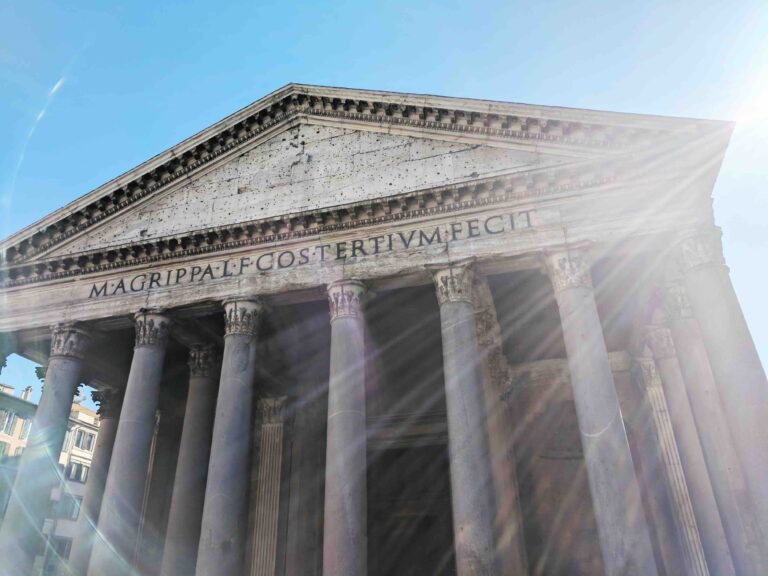
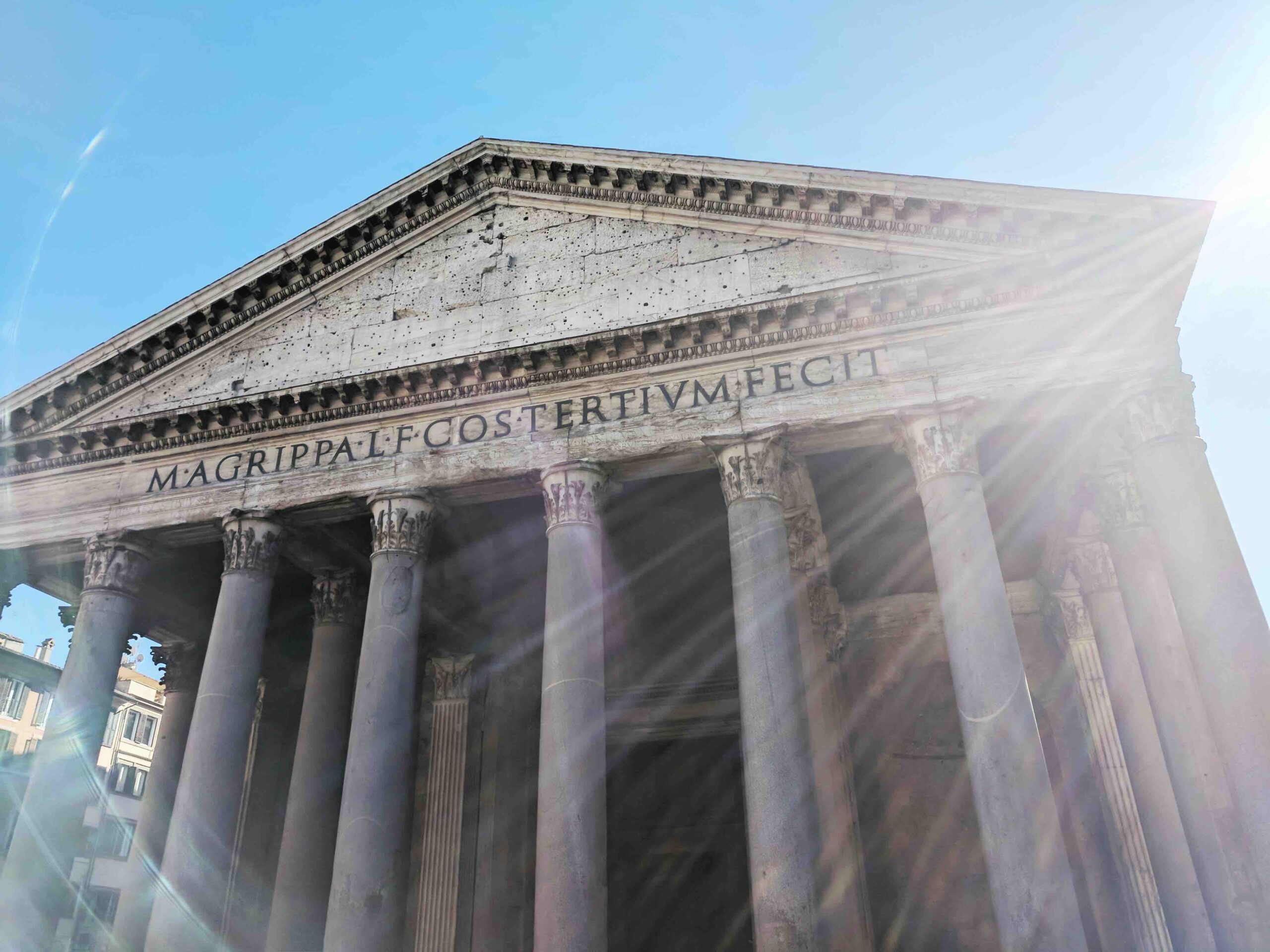
“M·AGRIPPA·L·F·COS·TERTIVM·FECIT”
At first glance, it looks like a code. But once translated into English, it becomes surprisingly simple:
“Marcus Agrippa, son of Lucius, consul for the third time, built this.”
That’s it. A straightforward statement from a powerful Roman leader named Marcus Agrippa. It tells us who he was and what he did. The letters M stands for Marcus, L·F means son of Lucius, COS·TERTIVM means consul for the third time, and FECIT means built this.
But here’s the mystery.
Marcus Agrippa did not build the Pantheon we see today.
The current structure is not his version. His original Pantheon burned down. The building we admire today was rebuilt by Emperor Hadrian around 126 AD. Yet Hadrian chose to leave Agrippa’s name on the front instead of carving his own.
Imagine building one of the greatest architectural wonders in history and giving the credit to someone else. That choice alone has fascinated historians for centuries.
Who Was Marcus Agrippa?
To understand why his name still stands proudly on the Pantheon facade, we need to know who Marcus Agrippa was.
Agrippa was more than just a politician. He was the right-hand man and closest friend of Emperor Augustus, the first emperor of Rome. While Augustus ruled, Agrippa built. He was responsible for many of the early public works in Rome, aqueducts, baths, temples, and of course, the first Pantheon, built around 27 BC.
He was a soldier, architect, engineer, and trusted advisor. Some say Augustus could never have risen to power without him. Agrippa was the kind of man Romans deeply respected. His name carried weight.
So when Hadrian rebuilt the Pantheon a century later, he chose not to erase that history. Instead of replacing Agrippa’s name with his own, Hadrian kept it. Some believe it was an act of humility. Others think it was political diplomacy, honoring Rome’s founding heroes to win public favor.
Whatever his reasons, Marcus Agrippa’s inscription survived while countless others faded away. It became one of the most recognizable Latin inscriptions in the world.
Why Did Hadrian Keep Agrippa’s Inscription?
Hadrian was not just another emperor. He was a traveler, a thinker, and a lover of art and architecture. He rebuilt more monuments than most rulers of his time. Yet unlike other emperors who stamped their names on every stone they touched, Hadrian chose restraint. When he reconstructed the Pantheon, he left Agrippa’s name untouched.
Why would he do that?
Historians suggest a few reasons:
1. Respect for Tradition. Romans admired their ancestors. Keeping Agrippa’s name honored the past and reminded people of Rome’s golden age under Augustus.
2. Political Strategy. Hadrian was not born in Rome. He came from Spain. Some say he avoided controversy by giving credit to a beloved Roman figure instead of promoting himself.
3. Humility, or the Appearance of It. Whether he truly felt humble or simply wanted to be seen that way, the effect was powerful. The Pantheon became a symbol of shared legacy rather than personal glory.
In a time when emperors fought for attention, Hadrian stepped back and let history speak for him. In doing so, he created one of the most enduring acts of preservation in architectural history.
Hidden Meanings and Symbolism Behind the Inscription
At first glance, the Pantheon inscription appears plain. But the more you look at it, the more you realize how carefully it was placed.
The lettering is large and bold, stretching across the entire front of the building. The words are carved in Roman capital letters, a style that later inspired modern fonts. Every letter was once inlaid with bronze, catching the light like gold. Even after centuries of erosion, the message still dominates the facade.
Some believe the inscription reflects more than credit, it reflects power. By placing Agrippa’s name on such a massive scale, Hadrian created a bridge between two empires: one ruled by Augustus, the other by himself.
Others see spiritual meaning. The Pantheon was originally a temple dedicated to all Roman gods. Writing the builder’s name on the front was like offering it to the gods as well. It was both a signature and a prayer.
So while the inscription is short, its presence is overwhelming. It is not simply carved, it declares itself.
Where Exactly Is the Pantheon Inscription Located?
You can’t miss it. The inscription sits right above the entrance, across the large stone beam called the architrave. It stretches from one column to the next, almost like a banner carved into the building itself.
But here’s a tip: most people stand too close when trying to read it. To see the inscription clearly, walk several meters back, far enough to take in the whole facade. From this distance, the letters become perfectly aligned. You’ll notice how clean and balanced they are, even after two thousand years.
Originally, the letters were filled with glowing bronze or gilded metal, so they would shine in the sun. Today only the carved outlines remain, but the effect is still powerful.
If you visit at sunset or early morning, the shadows make the inscription even more dramatic. The light falls across the letters, making them stand out like fresh engravings.
Are There Other Inscriptions Inside the Pantheon?
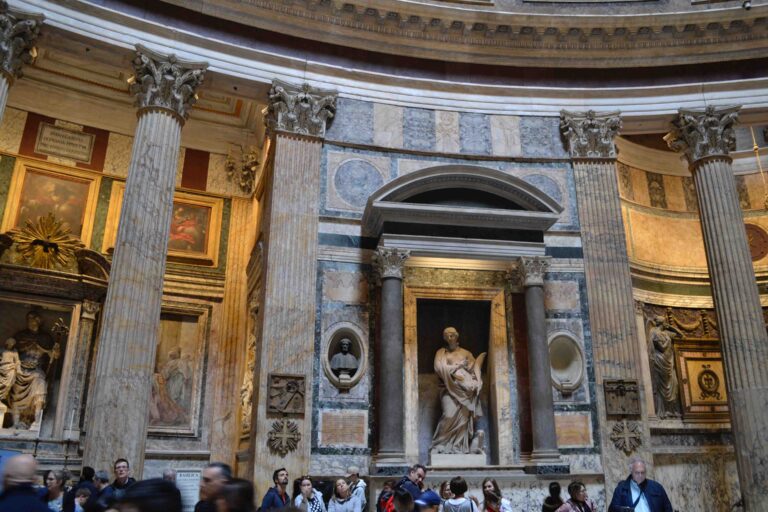
The famous inscription on the facade is just the beginning. Once you step inside the Pantheon, the building tells more stories, not in one line of Latin, but through Christian inscriptions, royal dedications, and tomb markers.
When the Pantheon was converted into a Christian church in 609 AD, it received a new name: Santa Maria ad Martyres, meaning Saint Mary and the Martyrs. A Latin dedication was added to mark its new purpose. This change helped save the Pantheon from being destroyed like many other pagan temples.
As you explore further, you’ll notice several memorial plaques and inscriptions inside. The most famous belong to King Vittorio Emanuele II and King Umberto I, both of whom are buried there. You’ll also find the tomb of Raphael, the Renaissance painter, marked with a poetic inscription chosen by his friend Pietro Bembo. It reads:
“Here lies Raphael, by whom Nature feared to be conquered while he lived, and when he died, feared to die.”
These later inscriptions show how the Pantheon transformed from a temple of gods into a house of memory, honoring artists, rulers, and saints alike.
How to Read the Pantheon Inscription During Your Visit
If you plan to visit, don’t rush past the entrance like most tourists. Take a moment and follow these steps:
- Step back far enough to view the whole facade. The best spot is usually near the edge of the square, where you can see the full front of the building.
- Say the inscription out loud slowly. It helps you feel the weight of each name and title: “Marcus Agrippa, son of Lucius, consul for the third time, built this.”
- Notice the spacing of the letters. Roman stonecutters used perfect proportions, this lettering style later became the model for modern capital letters.
- Look for the missing bronze pegs. If you get close enough, you can still see tiny holes where the metal letters were once attached.
- Compare it with modern plaques nearby. Most visitors do not realize this inscription is older than nearly every building still standing in Rome.
Reading it in person makes you feel like you’re reading a message directly from ancient Rome, no glass case, no museum label, just raw history carved in stone.
Fun Facts and Myths About the Pantheon Inscription
Over the centuries, the Pantheon inscription has collected stories, some true, some imagined. Here are a few of the most interesting ones:
- Myth: Agrippa built the Pantheon we see today.
Many people still believe this, but it is false. His original structure burned down, and Hadrian rebuilt it entirely. Only the inscription remained. - Fact: The bronze letters were removed by a pope.
In the 17th century, Pope Urban VIII Barberini ordered the bronze letters and roof beams to be taken down and melted. Some were used to make cannons and even a baldachin in St. Peter’s Basilica. Romans mocked him with the saying: “What the barbarians did not do, the Barberini did.” - Myth: There was another secret inscription beneath it.
Some believe a second dedication was once carved beneath Agrippa’s line, crediting Hadrian. So far, there is no evidence, but archaeologists still debate it. - Fact: The inscription inspired modern typography.
The bold Roman capital letters seen on the Pantheon facade helped inspire the development of Times New Roman and other modern fonts.
These little details make the inscription more than just a line of text, it becomes a legend.
Similar Inscriptions on Other Roman Monuments
Once you understand the Pantheon inscription, you start noticing how Romans used writing as a form of power. Many monuments across the city carry bold Latin inscriptions just like it, each one designed to be seen, remembered, and repeated.
Here are a few that share the same spirit:
- The Colosseum once had a long bronze inscription across its entrance. It named Emperor Vespasian and Titus as the builders. Only the holes where the metal letters were fixed remain today, just like at the Pantheon.
- The Arch of Titus, near the Roman Forum, carries an inscription celebrating the victory over Jerusalem. Instead of modesty, this one is full of pride and triumph.
- The Trevi Fountain, although much later, still follows the Roman tradition. Its inscription credits Pope Clement XII for commissioning the fountain, using a format very similar to imperial dedications.
Roman leaders didn’t rely on social media or news reporters, they carved their legacy into stone. The Pantheon Rome inscription is one of the clearest examples of how a single line can last longer than any speech or statue.
Frequently Asked Questions
Why is the Pantheon inscription important?
Because it connects two major eras of Roman history, the age of Augustus through Agrippa, and the age of Hadrian through the building itself. It is both a tribute and a message of continuity.
Did Agrippa really build the Pantheon?
He built the first version around 27 BC, but it was destroyed by fire. The Pantheon we see today was built by Emperor Hadrian around 126 AD. Only the inscription keeps Agrippa’s name alive on it.
Why did Hadrian leave Agrippa’s name instead of his own?
Historians believe it was out of respect, political wisdom, or a desire to honor Rome’s past rather than emphasize himself.
What material were the inscription letters made from?
Originally, the letters were filled with bronze or gilded metal, making them shine in the sunlight. Today, only the carved outlines remain.
How old is the Pantheon inscription?
The inscription dates back to 27 BC, making it over 2,000 years old, even older than the structure it sits on.
Final Thoughts — A Message That Outlived Empires
The Pantheon is famous for its perfect dome and mysterious oculus, but its true soul lies in the words above the entrance. That ancient inscription has survived fires, invasions, religious changes, and modern tourism. Emperors came and went. Kingdoms rose and fell. Yet M·AGRIPPA·L·F·COS·TERTIVM·FECIT still stands.
Maybe that’s what makes it so powerful. It isn’t poetic or dramatic. It doesn’t try to impress. It simply states, “I built this.” And two thousand years later, people still repeat his name.
So the next time you stand in front of the Pantheon, don’t just take a photo and walk inside. Look up. Read the line. Feel the weight of time in every letter. You’re not just looking at a building, you’re reading the oldest signature in Rome.